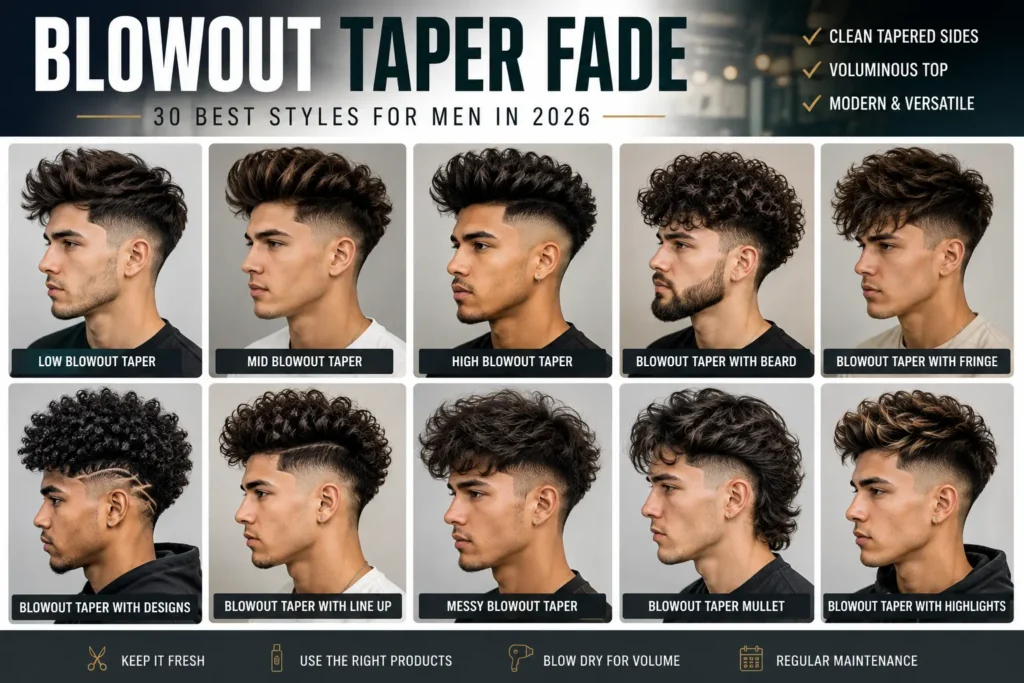
BLOWOUT TAPER FADE: 30 BEST STYLES FOR MEN IN 2026
The blowout taper fade combines clean tapered sides with longer, voluminous hair on top that is styled upward and outward. The result is a modern men’s haircut with movement, texture, and a fuller-looking silhouette.
Unlike a simple taper that can be worn naturally, the blowout effect depends heavily on how the top is styled. Your barber creates the shape and leaves enough length, while a blow dryer and suitable styling product help create the signature volume.
Whether you have straight, wavy, curly, thick, or textured hair, there is a blowout taper fade that can be adapted to your natural hair.
In this guide, you’ll find 30 blowout taper fade styles, plus advice on choosing the right version for your hair type and face shape, what to tell your barber, how to style it, how often to maintain it, and what mistakes to avoid.
What Is a Blowout Taper Fade?
A blowout taper fade combines two important elements: a tapered fade around the sides and neckline and a voluminous top styled with a blow dryer.
The sides gradually become shorter around the temples, ears, and neckline, while the top is left longer so it can be lifted and directed outward.
The word “blowout” refers mainly to the styling technique, not a special cutting method. The haircut gives you the foundation, but the blow dryer creates the volume and movement that define the finished look.
Blowout vs Taper vs Fade
These terms are often confused.
A taper gradually reduces the length around areas such as the sideburns and neckline.
A fade creates a more noticeable transition from longer hair into very short or skin-level hair.
A blowout describes the voluminous styling of the longer hair, usually created with a blow dryer.
Put them together and you get a haircut with cleaner sides, a tapered perimeter, and a lifted, fuller top.
30 Best Blowout Taper Fade Styles for Men
1. Classic Blowout Taper Fade
The classic blowout taper fade is the easiest version to start with.
The sides stay clean and gradually tapered, while the top is kept at a medium length and styled upward and outward.
It gives you noticeable volume without looking overly extreme.
Best for: First-time blowout taper wearers and everyday styling.
2. Low Blowout Taper Fade
A low blowout taper keeps the taper close to the ears and neckline.
Because less hair is removed from the sides, the result looks softer and more natural than a high taper.
It is also one of the easiest versions to wear in professional or school environments.
Best for: A subtle, clean appearance.
3. Mid Blowout Taper Fade
The mid blowout taper sits higher on the sides and creates more contrast between the voluminous top and shorter sides.
It offers a good middle ground between a subtle low taper and a dramatic high taper.
Best for: Men who want a versatile modern haircut.
4. High Blowout Taper Fade
The high blowout taper creates the strongest contrast.
The taper or fade begins higher around the sides, making the longer hair on top appear even fuller.
This version works particularly well when you want your hairstyle to make a statement.
Best for: Bold looks and thick hair with plenty of volume.
5. Blowout Taper Fade With Textured Top
Instead of making the top perfectly smooth, the barber adds texture so the hair has more separation and movement.
A matte styling product can enhance the texture without making the hair look greasy.
Best for: Thick or naturally textured hair.
6. Curly Blowout Taper Fade
Curly hair already has natural volume, which makes it a great match for a blowout taper.
The taper keeps the sides controlled while the curls create height and movement on top.
For curly hair, a diffuser can often work better than aggressively brushing the curls straight.
Best for: Curly and coily textures.
7. Wavy Blowout Taper Fade
Wavy hair gives the blowout a relaxed, natural texture.
Instead of forcing the hair completely straight, work with the natural wave pattern and direct it upward and outward while drying.
A lightweight mousse or sea-salt spray can add texture without making the hair heavy.
Best for: Naturally wavy hair.
8. Blowout Taper Fade for Straight Hair
Straight hair can absolutely work with a blowout taper, but it usually needs more help creating volume.
The key is using a volumizing product at the roots and blow-drying the hair against its natural direction.
A lightweight matte product can then help hold the finished shape.
Best for: Straight hair that needs extra lift.
9. Blowout Taper Fade With Fringe
A textured fringe gives the blowout a more forward-focused shape.
Instead of directing every strand upward, some of the front hair falls naturally toward the forehead.
This creates a softer and more youthful appearance.
Best for: Men who want volume without a completely exposed forehead.
10. Blowout Taper Fade With Beard
Adding a beard creates a stronger connection between the haircut and facial hair.
The taper can be blended carefully into the sideburn area so the transition looks natural.
Keep the beard edges clean to maintain the sharpness of the haircut.
Best for: Men with short or medium-length beards.
11. Blowout Taper Fade With Line Up
A line up creates sharper definition around the forehead and temples.
It contrasts nicely with the softer movement of the blowout on top.
However, don’t ask your barber to push the hairline too far backward simply to make it appear straighter.
Best for: Men who prefer crisp, defined edges.
12. Blowout Taper Fade With Side Part
A side part gives the voluminous haircut a more structured appearance.
You can keep the part natural or ask your barber for a subtle defined part.
This version works particularly well when you want the haircut to transition easily between casual and formal settings.
13. Messy Blowout Taper Fade
The messy version is designed to look intentionally relaxed.
Instead of creating perfectly controlled volume, allow the top to have uneven texture and movement.
A matte clay or texture cream can help create this finish.
Best for: Casual, effortless styling.
14. Blowout Taper Fade With Volume
If maximum volume is your goal, keep more length on top.
The barber should shape the hair without removing too much density.
When styling, lift the roots with a blow dryer and direct the hair outward to create the rounded blowout silhouette.
15. Blowout Taper Fade With Hard Part
A hard part creates a clearly defined separation between sections of the haircut.
Combined with the blowout, it creates a more dramatic and polished appearance.
This style requires regular maintenance because the shaved part becomes less defined as it grows.
16. Blowout Taper Fade Mullet
A blowout taper can be combined with a mullet by keeping extra length toward the back.
The sides remain clean while the longer back creates a more noticeable silhouette.
This is a much more fashion-forward option than the classic blowout taper.
Best for: Men who want an experimental haircut.
17. Blowout Taper Fade With Skin Fade
For maximum contrast, the lower sides can be faded down to skin.
The clean skin-level section makes the longer hair on top appear even fuller.
Keep in mind that this version generally requires more frequent touch-ups to maintain its sharp appearance.
18. Blowout Taper Fade With Designs
Hair designs can be added to the faded section for a personalized finish.
A simple line can look clean and understated, while more complex patterns create a statement style.
Because the hair grows quickly, designs usually need frequent refreshes.
19. Blowout Afro Taper Fade
Afro-textured hair can create an especially strong blowout silhouette because of its natural density and volume.
The taper cleans up the perimeter while the top remains full.
The exact length should be chosen according to your natural texture and preferred shape.
20. Blowout Taper Fade for Thick Hair
Thick hair is naturally suited to a voluminous haircut.
The main challenge is controlling excess bulk without making the top look thin.
Ask your barber to shape the weight strategically rather than removing too much density.
21. Blowout Taper Fade for Fine Hair
Fine hair can still achieve a good blowout, but technique becomes more important.
Keep enough length on top to create height and use lightweight volumizing products.
Avoid heavy waxes and greasy products that can make fine hair appear flatter.
22. Blowout Taper Fade for Long Hair
Longer hair gives you more styling possibilities.
You can create a dramatic blowout with substantial height and movement, or keep the volume more controlled.
The sides should remain balanced with the extra length on top so the haircut doesn’t look disconnected.
23. Short Blowout Taper Fade
You don’t need extremely long hair for a blowout effect.
A shorter version can use texture and root lift to create a compact, clean silhouette.
It is easier to maintain than a longer blowout and works well for men who don’t want a long styling routine.
24. Blowout Taper Fade With Blonde Hair
Blonde hair can make the texture and separation of the blowout more noticeable.
Whether the hair is naturally blonde or colored, keeping the sides clean creates contrast with the lighter top.
Use products that don’t leave excessive buildup or dull the hair.
25. Blowout Taper Fade With Highlights
Highlights can emphasize individual sections of the voluminous top.
They are especially effective on textured or wavy hair because different strands catch the light differently.
Keep the color subtle if you want a more natural finish.
26. Blowout Taper Fade With Curly Fringe
This version combines a voluminous curly top with a fringe that falls slightly toward the forehead.
The taper keeps the sides neat while the curls create a softer shape around the front.
Best for: Naturally curly hair with good definition.
27. Blowout Taper Fade With Perm
A perm can add waves or curls to naturally straight hair, making it easier to create a textured blowout.
However, the haircut should be planned around the expected curl pattern rather than the hair’s appearance before the perm.
Best for: Straight-haired men who want more texture.
28. Blowout Taper Fade With Natural Texture
You don’t always need a dramatic styling routine.
For naturally textured hair, simply use a lightweight product and direct the hair with your fingers while blow-drying.
This creates a relaxed blowout that still looks intentional.
29. Professional Blowout Taper Fade
A professional version keeps the volume controlled and the taper relatively subtle.
Avoid excessive designs, extreme height, or overly sharp contrasts if you need a conservative appearance.
A low or mid taper is usually easier to adapt to professional settings.
30. Modern Blowout Taper Fade
The modern version combines clean edges, textured volume, and a slightly relaxed finish.
Instead of making every strand perfect, allow natural movement to remain visible.
This makes the haircut feel current without relying on one specific trend.
Which Blowout Taper Fade Should You Get?
Choosing the right version becomes much easier when you consider three things: taper height, hair texture, and face shape.
Low vs Mid vs High Blowout Taper
| Style | Look | Best For | Maintenance |
|---|---|---|---|
| Low | Subtle & natural | Professional looks | Lower |
| Mid | Balanced & versatile | Most face/hair types | Medium |
| High | Bold & high contrast | Thick hair & dramatic looks | Higher |
Choose a Low Blowout Taper If:
- You want a natural look
- You prefer more hair around the sides
- You work in a conservative environment
- You’re getting your first blowout taper
Choose a Mid Blowout Taper If:
- You want balanced contrast
- You want a modern everyday haircut
- You aren’t sure which taper to choose
- You have medium or thick hair
Choose a High Blowout Taper If:
- You want maximum contrast
- You like bold hairstyles
- You have plenty of volume on top
- You don’t mind more frequent maintenance
Which Hair Type Is Best for a Blowout Taper Fade?
Straight Hair
Straight hair usually needs the most styling assistance.
Use a volumizing product before blow-drying and lift the roots as you dry.
Don’t overload the hair with heavy products because they can quickly remove the volume you’re trying to create.
Wavy Hair
Wavy hair is naturally suited to a relaxed blowout.
Work with your existing texture instead of trying to completely straighten it.
A lightweight mousse or texture spray can help emphasize movement.
Curly Hair
Curly hair can create excellent natural volume.
Use curl-friendly products and consider a diffuser if you want to preserve the curl pattern.
The taper should frame the curls rather than removing too much volume from the top.
Thick Hair
Thick hair provides plenty of natural fullness.
The main goal is controlling excess weight while preserving enough density for the blowout.
Fine Hair
Fine hair benefits from root-lifting techniques.
Keep the product lightweight and focus on creating volume at the roots rather than applying large amounts of product throughout the hair.
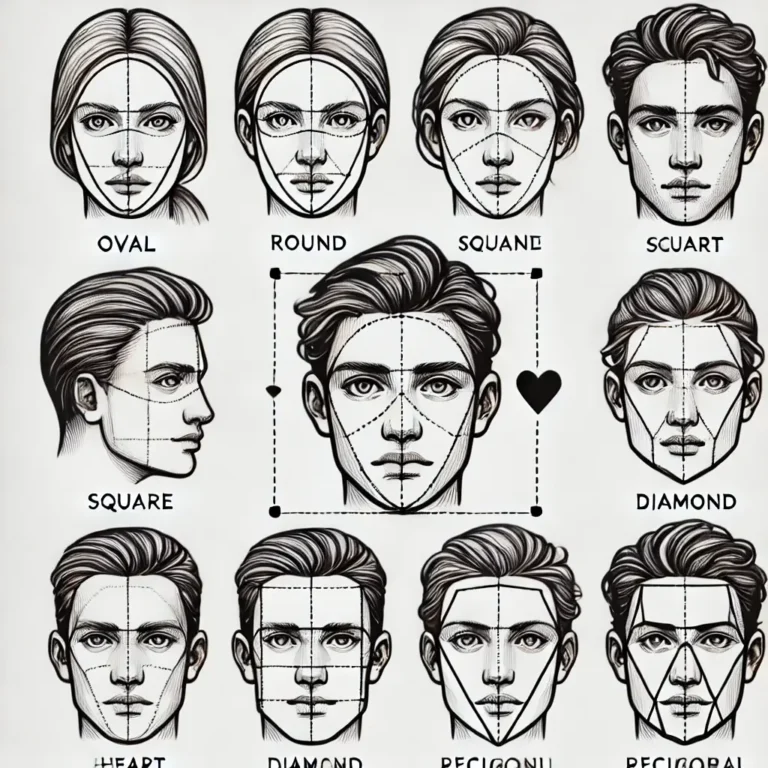
Best Blowout Taper Fade for Your Face Shape
Oval Face
Almost every variation can work with an oval face.
A low, mid, or high taper can be selected according to your preferred level of contrast.
Round Face
A little extra height on top can help create a visually longer appearance.
A mid or high taper can work well if you want stronger contrast.
Square Face
A square face already has strong angles.
A clean mid taper with controlled volume can complement those natural proportions.
Oblong Face
If your face is longer, avoid creating excessive vertical height.
A lower taper and moderate top volume can provide better balance.
Diamond Face
A moderate taper with controlled volume around the upper sides can complement the narrower forehead and jawline.
How Long Should Your Hair Be for a Blowout Taper?
There is no single perfect length.
However, you need enough length on top to create visible lift and movement.
If your hair is extremely short, the haircut may look more like a textured taper than a traditional blowout.
Medium-length hair generally gives you more styling flexibility.
If you’re growing your hair specifically for this haircut, tell your barber that you want to preserve enough length for a blowout rather than simply asking for a short taper.
What to Tell Your Barber
One of the biggest mistakes is simply saying:
“Give me a blowout taper.”
That doesn’t tell your barber how high you want the taper or how much length you want to keep.
Instead, use a more specific request.
Simple Barber Script
“I want a blowout taper fade with enough length on top to create volume and movement. Keep the sides clean but don’t take the taper too high. I want the top styled upward and outward, and I want to keep my natural texture.”
Then specify:
- Low, mid, or high taper
- How much length you want on top
- Whether you want a fringe
- Whether you want a line-up
- Whether you want the neckline natural or clean
- Whether you want a beard blend
Best Tip
Bring 2–3 reference photos showing the front, side, and back.
A photo that has a similar hair texture to yours is much more useful than simply showing a haircut with a completely different hair type.
How to Style a Blowout Taper Fade
Getting the haircut is only half the process. The signature blowout effect comes from styling.
Step 1: Start With Damp Hair
After washing, gently towel-dry your hair.
Don’t aggressively rub the hair, especially if it is curly or wavy.
Step 2: Apply a Lightweight Product
Depending on your hair type, use:
- Volumizing mousse
- Lightweight styling cream
- Texture spray
- Curl cream
- Heat protectant
Start with a small amount.
Step 3: Lift the Roots
Use a blow dryer to lift the hair from the roots.
Direct the airflow upward and outward rather than simply blowing straight down.
Step 4: Shape the Top
Use your fingers, a round brush, or a vent brush depending on your hair texture.
Shape the hair in the direction you want it to sit.
Step 5: Finish With a Small Amount of Product
Once the hair is dry, use a small amount of matte clay, styling cream, or another suitable finishing product.
Don’t overload the hair.
The goal is volume + movement, not stiff, helmet-like hair.
How to Maintain a Blowout Taper Fade
A blowout taper can look excellent when fresh, but the tapered areas become less defined as the hair grows.
For a consistently sharp appearance, many people choose a haircut refresh roughly every 2–4 weeks, depending on how quickly their hair grows and how clean they want the taper to look.
Between Haircuts:
- Keep the neckline clean.
- Don’t overuse heavy styling products.
- Wash according to your hair type.
- Use conditioner when appropriate.
- Protect your hair from excessive heat.
- Refresh the taper when the edges start losing definition.
A longer top can usually be maintained while getting only the sides and neckline cleaned up.
Common Blowout Taper Fade Mistakes
1. Cutting the Top Too Short
The blowout depends on enough length to create volume.
If too much is removed, there may not be enough hair to produce the desired shape.
2. Choosing a Taper That Is Too High
A high taper creates stronger contrast.
If you want a subtle look, start lower.
3. Using Too Much Product
More product doesn’t always mean more volume.
Heavy products can actually flatten the hair.
4. Skipping Heat Protection
If you’re regularly blow-drying your hair, a heat protectant can help reduce heat-related damage.
5. Ignoring Your Natural Hair Texture
Straight, wavy, curly, and coily hair behave differently.
Your styling method should work with your natural texture rather than fighting it every day.
6. Showing Your Barber the Wrong Reference
A reference photo with completely different hair density or texture may not translate exactly to your hair.
Choose a photo that resembles your own hair as closely as possible.
Blowout Taper Fade vs Regular Taper Fade
The biggest difference is the styling on top.
A regular taper fade can be worn naturally, textured, slicked back, cropped, or styled in many different ways.
A blowout taper specifically focuses on creating lift, volume, and outward movement.
Blowout Taper Fade
- More volume
- More movement
- Requires blow-drying
- Longer top
- More dramatic silhouette
Regular Taper Fade
- More versatile
- Can require little styling
- Can work with shorter hair
- Usually easier to maintain
If you love volume and don’t mind spending a few minutes styling your hair, the blowout taper is worth considering.
Blowout Taper Fade vs Blowout Taper: What’s the Difference?
These names are often used interchangeably, but there can be a visual difference.
A blowout taper generally emphasizes a softer taper around the perimeter.
A blowout taper fade usually has a more noticeable fade or shorter transition on the sides.
If you want the sides to remain fuller and more natural, ask for a taper.
If you want stronger contrast and shorter sides, ask for a fade.
Always show your barber a reference photo because terminology can vary between barbers.
Is a Blowout Taper Fade Low Maintenance?
The answer depends on what you mean by maintenance.
The haircut itself can be relatively easy to maintain, especially with a low taper.
However, the blowout styling requires more daily effort than a basic taper.
If you want the volume every day, expect to spend some time blow-drying and shaping the top.
If you don’t want daily styling, choose a shorter textured version that can be worn more naturally.
Is a Blowout Taper Fade Good for Thin Hair?
Yes, but the haircut needs to be adapted.
Volume can make fine hair appear fuller, but heavy products and excessive length can have the opposite effect.
Keep the top at a manageable length and use lightweight volumizing products.
The goal is to create root lift without weighing down the strands.
Is a Blowout Taper Fade Good for Curly Hair?
Absolutely.
Curly hair naturally creates volume and texture, making it one of the easiest textures to adapt to a blowout-inspired style.
Instead of brushing the curls straight, you can use a diffuser to enhance their natural shape while keeping the tapered sides clean.
Frequently Asked Questions
What is a blowout taper fade?
A blowout taper fade combines tapered or faded sides with longer hair on top that is styled upward and outward to create volume, movement, and texture.
How long does your hair need to be for a blowout taper?
There is no exact minimum length, but the top needs enough length to be lifted and shaped. Medium-length hair generally provides more flexibility.
Is a blowout taper fade good for straight hair?
Yes. Straight hair can achieve a blowout taper with the help of volumizing products and proper blow-drying technique.
Is a blowout taper fade good for curly hair?
Yes. Curly hair naturally provides volume and texture, making it well suited to a blowout taper.
Which is better: low or high blowout taper?
A low taper is better for a subtle, professional appearance, while a high taper creates stronger contrast and a more dramatic style.
How often should I get a blowout taper fade?
A refresh every 2–4 weeks is common for keeping the taper looking clean, although the ideal schedule depends on your hair growth and preferred appearance.
Can you get a blowout taper with a beard?
Yes. The taper can be blended into the sideburn and beard area to create a connected look.
Can thin hair get a blowout taper fade?
Yes. Keep enough length on top for volume and use lightweight products designed to create lift without weighing the hair down.
Does a blowout taper fade require daily styling?
For the full blowout effect, some daily styling is usually needed. A shorter textured version can require much less effort.
What product is best for a blowout taper?
The best product depends on your hair type. Lightweight mousse or volumizing products work well for fine or straight hair, while texture creams and curl products may be better for wavy or curly hair.
Final Thoughts
The blowout taper fade is a versatile men’s haircut that combines clean, tapered sides with volume and movement on top.
The best version isn’t necessarily the highest or most dramatic one. It is the version that matches your hair texture, face shape, lifestyle, and willingness to style your hair.
Choose a low taper for a softer appearance, a mid taper for balanced contrast, or a high taper if you want a bold finish.
And before your appointment, don’t just tell your barber that you want a blowout taper fade. Show a reference photo, explain your preferred taper height, and make sure enough length remains on top for the volume you want.
With the right cut and styling technique, a blowout taper fade can give you a clean silhouette while keeping the natural character of your hair.